
Starmer’s proposed under-16 social media ban has produced the usual festival of certainty.
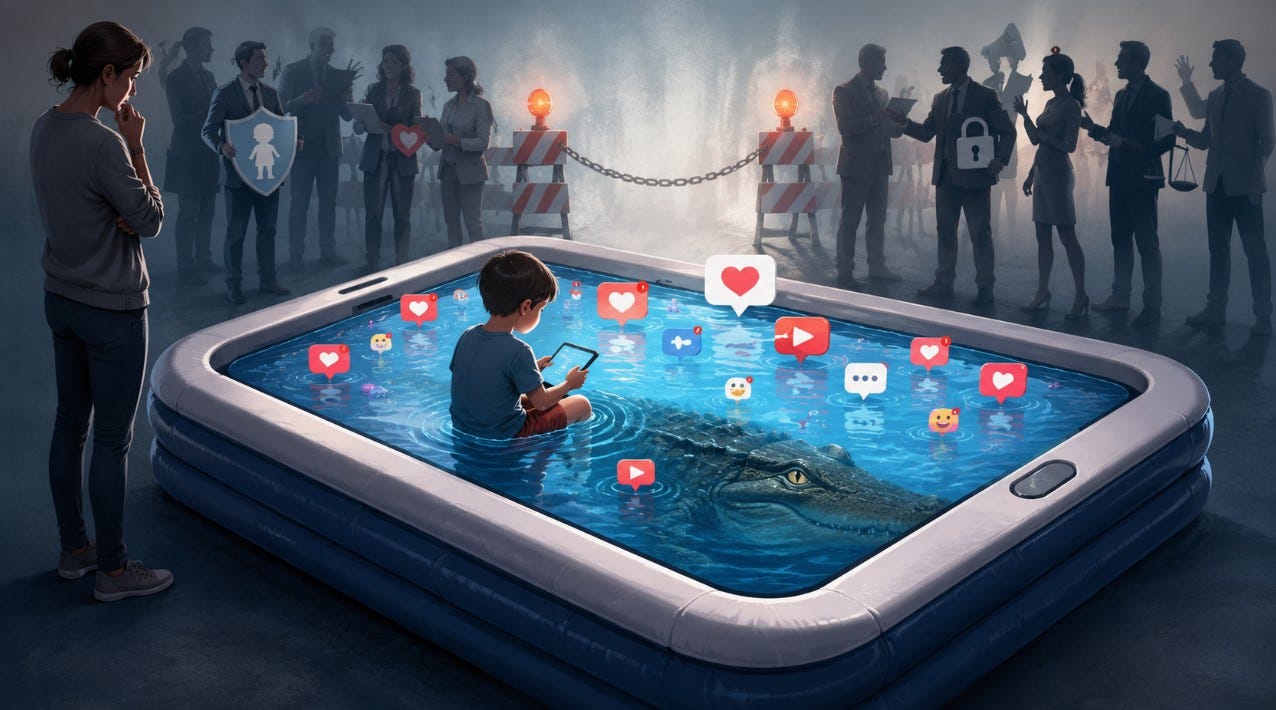
On one side are people shouting dictatorship, as if preventing children from being fed into TikTok’s behavioural mincer is the first step towards a police state. On the other side are the more respectable critics, including the NSPCC, who say the real answer is not a ban but making platforms safe by design.
And that sounds admirable. Of course it does. Safe by design is what everyone wants. Nobody sensible wants children wandering through algorithmic slot machines, stranger contact, cyberbullying, eating disorder content, self-harm material and whatever fresh little sewer the attention economy has decided to monetise this week.
The trouble is that safe by design may also be a bit like asking a crocodile to redesign the nursery paddling pool. You do not throw out the imperfect while waiting for the perfect, especially when the perfect is currently being promised by the same companies that built the problem.
The NSPCC’s argument is not stupid. In fact, it is the right long-term destination. Platforms should be made safer. Algorithms should be regulated. Addictive features should be curbed. Adults contacting children should be easier to detect and stop. Companies should carry the burden, not parents sitting at the kitchen table trying to outwit a multinational corporation between packed lunches and the school run.
But safe by design assumes the platforms can be made safe quickly, honestly and reliably. That is quite a large assumption to place on businesses whose entire model is to keep people looking, scrolling, reacting and coming back for another little dopamine biscuit.
This is where the politics gets rather revealing. The protect our women and children crowd do have a habit of falling over their own slogans.
When immigration, asylum or street crime is being discussed, the precautionary principle is suddenly sacred. One unknown adult is too many. One risk is too many. One failure by the state is unforgivable. They do not ask whether protection is too statist, too interventionist, or a slippery slope towards tyranny. Protection, at that point, is apparently the first duty of government.
But put the risk inside a phone, attach it to a private company, and suddenly the same people discover a touching new enthusiasm for parental responsibility, limited government and thirteen-year-olds managing their own exposure to predators, algorithms and strangers on Snapchat.
It is a curious sort of child protection that becomes passionate only when it can be aimed at foreigners.
That does not make Starmer’s proposal perfect. Far from it. Age verification has obvious dangers. Privacy matters. Mission creep matters. A general digital checkpoint for the internet would be a rotten idea, and anyone who waves that concern away as paranoia has not been paying attention to how governments and corporations behave once a useful little lever has been installed.
But a ban being crude does not automatically make it wrong. We do not let children into betting shops because Ladbrokes has promised a gentler carpet. We do not let children buy cigarettes because the packet has a warning on it. We do not say pubs should simply be redesigned so that thirteen-year-olds can drink in a safer, more inclusive and stakeholder-approved way.
At some point society draws a line and says: below this age, you do not get the customer.
That is not dictatorship. It is the ordinary business of protecting children from markets they are not equipped to navigate. And social media is very much a market, however much it dresses itself up as connection, community and little hearts floating about under someone’s breakfast.
Nor is the phrase VPN quite the devastating point some people seem to think it is. Yes, some children will evade it. Some children get alcohol. Some children smoke. Some children carry knives. We do not therefore abolish alcohol laws, cigarette laws or knife laws because enforcement is imperfect.
The point of age restrictions is not perfection. It is changing the default. It shifts responsibility away from millions of individual parents fighting a private war against addictive design, and puts it where it belongs: on the companies making money from children’s attention.
There is a valid civil liberties objection here, but it needs to be made properly. If this becomes a back-door digital ID system for every adult using the internet, it should be opposed. If it creates a state database of browsing habits, it should be opposed. If it becomes a convenient mechanism for deciding which political material adults are allowed to see, it should be opposed loudly and without apology.
But protecting children online does not automatically mean tyranny. That is the leap being made, and it is doing a lot of work.


No comments:
Post a Comment