
There is something wonderfully revealing about the way the word terrorism behaves in British public life.
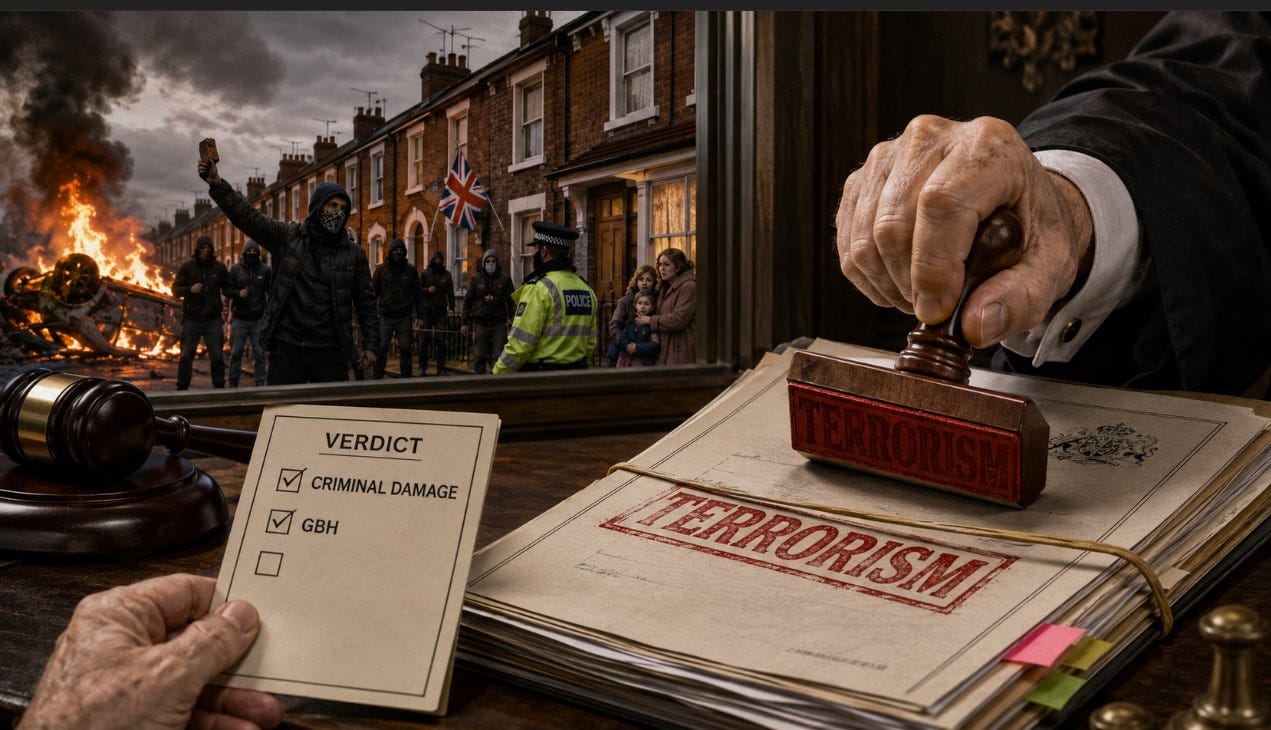
When Palestine Action activists broke into a defence factory, caused serious damage, and one of them was later convicted of GBH without intent, the word suddenly became very available. It was taken down from the legal shelf, dusted off, and applied with great solemnity. This was not just criminal damage and a serious assault conviction, we were told. It had a political purpose. It was ideological. It had a terrorist connection.
And here is the odd bit. They were not charged with terrorism. They were not convicted by a jury of terrorism. They were convicted of ordinary criminal offences, and then the terrorism label arrived at sentencing, after the verdict, like an especially sinister after-dinner mint.
That may be what the law allows. In fact, that is rather the point. Sometimes the problem is not that someone has broken the law, but that the law has been written with enough elastic in it to fit whatever the state finds convenient.
And that is chilling.
There is a statutory threshold, of course. This is not a judge wandering into court with a hat full of adjectives. But it is still broad, fact-sensitive, and applied after conviction by the sentencing judge. One judge may call it terrorism-connected offending. Another may call it serious politically motivated criminal damage and violence.
That is not arbitrary in the pub sense. It is not someone tossing a coin. It is worse than that: a huge label depending on one judge’s view after the jury has gone home.
Because when the state thought Irish republican or loyalist violence was terrorism, it did not usually convict people of ordinary offences and then discover the terrorism bit at sentencing. The terrorism machinery was there from the beginning: arrest powers, proscribed organisations, explosives offences, membership allegations, scheduled offences, Diplock courts, the whole grim cupboard. Whatever one thinks of that machinery, it was not slipped in afterwards like a surprise service charge.
So apply the same eye to Belfast. Masked mobs. Homes thought to house migrants. Minority-owned businesses. Cars and buses burned out. Police attacked. Local families terrified in their own streets.
That is not community concern. It is not ordinary people pushed too far. To my untrained eye, it looks rather a lot like terror. If terrorism law can reach a sledgehammer in a factory, it can surely notice a petrol bomb near someone’s home.
And yet, oddly enough, people who were not charged with terrorism can acquire the label at sentencing, while people whose alleged conduct looks much closer to ordinary ideas of terrorism are discussed as rioters, thugs, protesters, or angry locals.
The language does a little curtsy depending on who is standing in the dock.
Of course terrorism law should be used carefully. That is precisely the point. The proper answer is not to prosecute every rioter as a terrorist, which would be absurd, and absurdity already has quite a busy schedule. The proper answer is to restrain the law so that terrorism means what ordinary people think it means: serious violence, threats to life, organised intimidation, and attempts to terrorise a population or section of it.
But if the state insists on using a definition wide enough to cover politically motivated property damage and serious violence, then it cannot pretend not to see politically motivated arson, mob violence and racial intimidation when they arrive wearing a different badge.
And if the state wants to attach that label to someone, it should have to prove it properly. Not by slipping it in at sentencing after a jury has convicted on ordinary criminal offences, but by charging it, arguing it, and having it tested before a jury.
An appeal may yet test this. I hope it does.
Because if the most serious word in criminal law can arrive after the verdict, by way of a sentencing exercise, then it is no longer quite a verdict. It is an upgrade package.


2 comments:
I must tread very carefully, Chairman, as I don't know the case. But my experience has been very different. Judges stick to the letter of the law: their sentencing comments aren't always accurately reported. A much more recent trend is for a senior police officer, or some other official, to make a public statement about the correctness of the verdict: justice vindicated, etc. At a local level, including BBC journalists, sometimes the judge is not quoted at all, or even identified, as though rather peripheral to the trial process. Reporting has now become far more media-orientated.
That is a fair caution, and I agree with much of it.
My point is not that judges are routinely freelancing or ignoring the law. In fact, part of the unease is precisely that they may be applying the law as written. The chilling effect comes when the law has enough elasticity that serious protest-related offending can be pulled towards the terrorism framework.
You are also right about reporting. Sentencing remarks are often reduced to a headline, and then the public narrative is shaped by police statements, official reaction and media shorthand. By the time it reaches most readers, the judge’s careful distinctions may have disappeared, leaving only the label.That is why I find it chilling. Not because I think criminal damage should be consequence-free, or because judges are villains, but because once terrorism language enters the process, it carries a moral charge far beyond ordinary criminal damage. It changes the public meaning of the offence.
The danger is not only in the sentence. It is in the reclassification. People may think they are risking arrest for protest or criminal damage, but the state, and then the media, may present them as something much closer to terrorists. That is a very different shadow to cast over dissent.
Post a Comment